

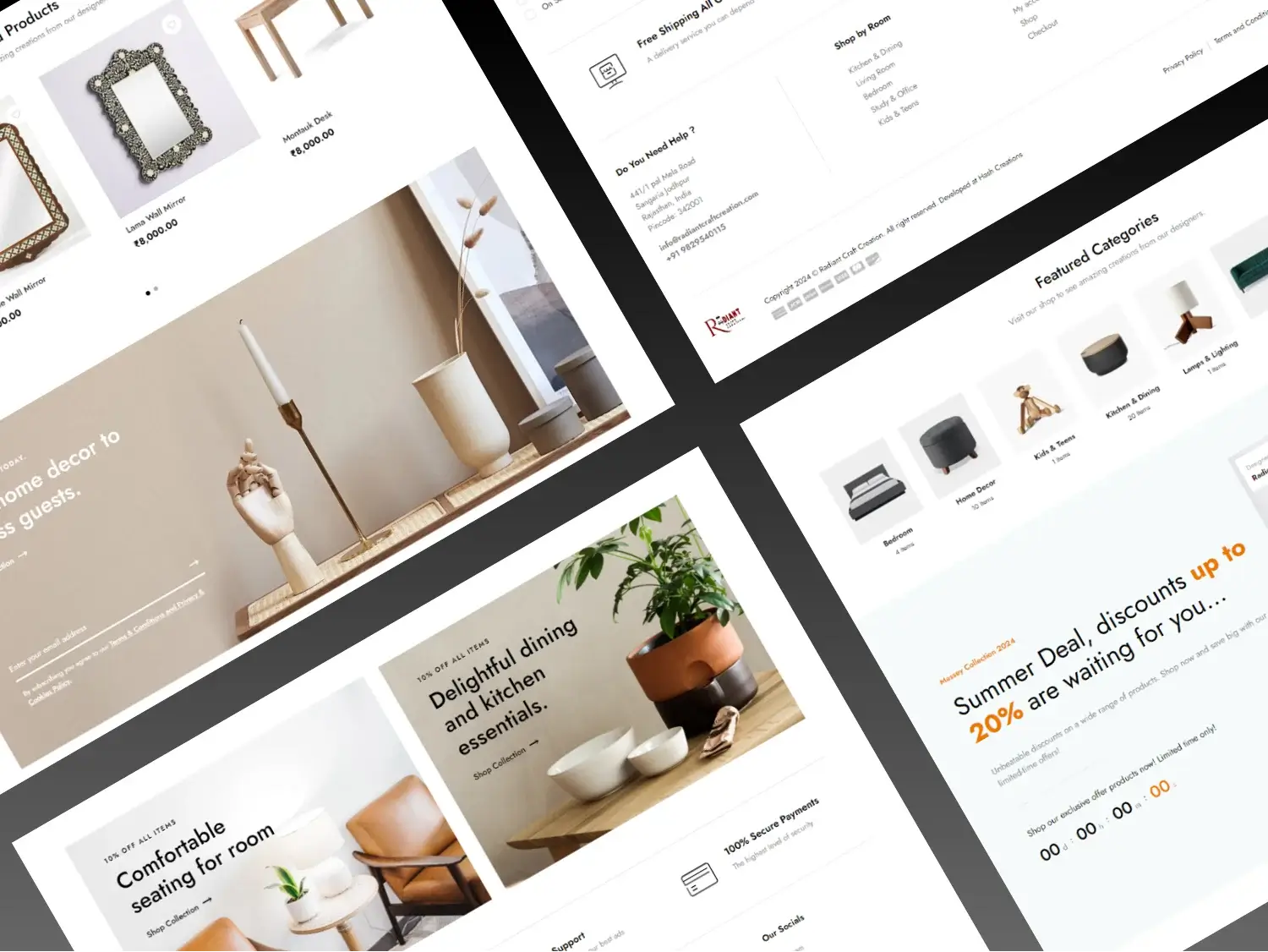
Radiant Craft Creation sells handcrafted products. Each item is effectively one of a kind, which makes the usual e-commerce assumptions — deep inventory, repeat SKUs, size matrices — a poor fit.
The Challenge
Handmade catalogues break standard storefront patterns:
- Stock is often a single unit, so "out of stock" is a normal state rather than a failure
- Every product needs its own photography; there is no template shot
- Buyers want to see craft detail, which means large images on a page that still has to load quickly
The bigger issue was checkout. A long, multi-step flow costs conversions on any store, and disproportionately so on impulse-led craft purchases.
What We Built
A storefront shaped around single-unit inventory and a deliberately short checkout.
Product pages built for detail
Each product gets full-width imagery with room for close-up craft detail, plus the practical information a buyer needs — materials, dimensions, and what "handmade" means for variance between items.
A checkout reduced to essentials
The flow collects only what is needed to take payment and ship the item. Fields that could be inferred or deferred were removed rather than merely reordered.
Honest stock states
Because one-of-a-kind is the norm, sold items are presented as a normal part of the catalogue rather than an error state — which keeps the archive working as a portfolio even after items sell.
Technology
Built on a Next.js storefront with an integrated payment gateway.
- Server-rendered product pages for indexable, shareable listings
- Optimised responsive imagery sized per breakpoint
- Secure hosted payment flow, so card details never touch the application
- Mobile-first cart and checkout
Results
The shorter checkout path is the change the business felt most directly.
On a craft store, every extra checkout field is a chance to reconsider the purchase.